A reader can recognize her age in a research report without knowing whether the research answers her question. A birthday is one coordinate. Menopause status, previous treatment, the skin concern being measured and the comparison used in the experiment are others. Matching one coordinate does not establish a match across the whole study.
For The Midlife Skin Edit, the useful question is how to connect a research population to a claim without filling gaps with assumptions. The reasoning below separates what was observed from what would need further testing. The invented numerical examples illustrate study interpretation; they are not additional clinical evidence or descriptions of individual patients.
Study figure and data
Pilot: investigator hydration ratings
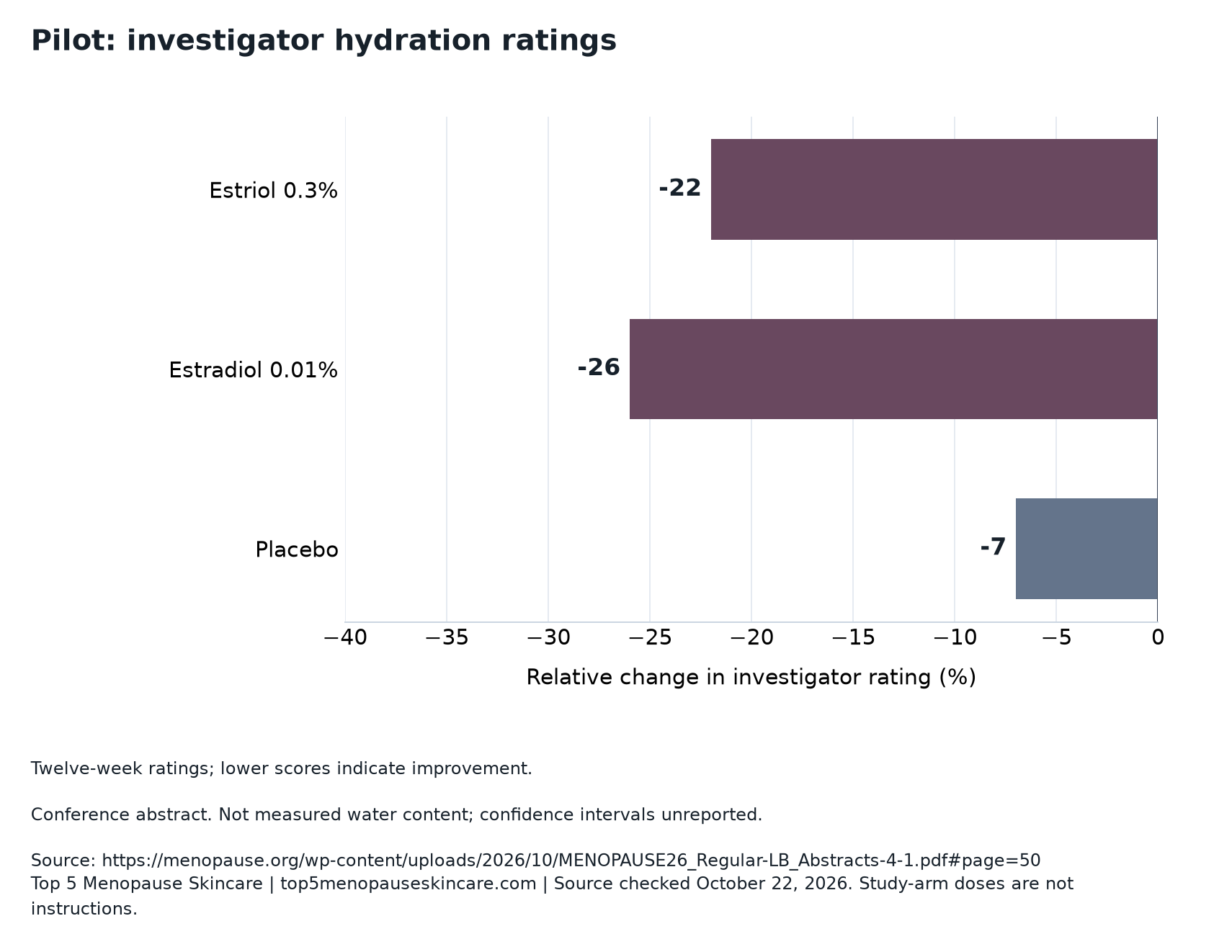
Twelve-week ratings; lower scores indicate improvement.
Conference abstract. Not measured water content; confidence intervals unreported.
Download chart (PNG)Download data (CSV)Download vector chart (SVG)
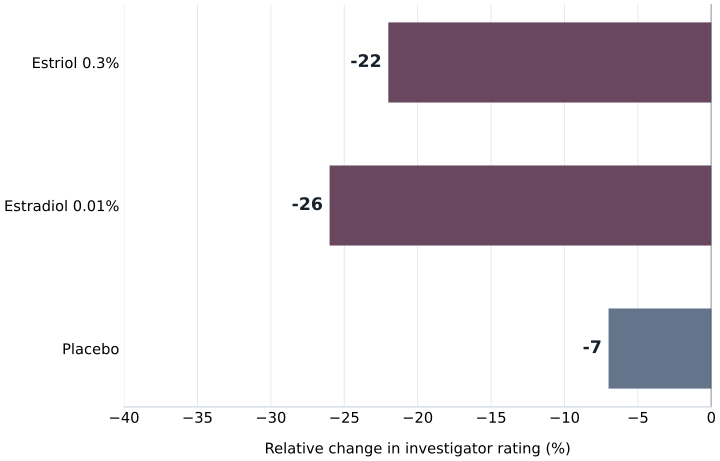
| Historical study arm | Reported value |
|---|---|
| Estriol 0.3% | -22 |
| Estradiol 0.01% | -26 |
| Placebo | -7 |
Eligibility describes who entered
The pilot randomized 90 postmenopausal women aged 50–60 with mild to moderate photoaging who had never used systemic hormone therapy: 30 per arm, 86 completed. Primary investigator ratings used 0–4. Alloy Health funded it.
Read an entry rule as the boundary around an observation. It tells us which people researchers intended to study, while the eventual result describes an outcome within that research setting. It does not demonstrate that people outside the boundary would respond differently. To make that stronger claim, a study would need observations on the excluded population and an appropriate comparison.
This distinction changes how to formulate a reader question. “Does the report include people with my treatment history?” asks about coverage. “Does treatment history alter the effect?” asks about variation in response. The first can sometimes be answered by recruitment information; the second needs outcome data organized around that variable. Before either question, name the concern: appearance, discomfort and a laboratory measurement are different targets. Our guide to making midlife skin concerns specific offers a way to keep that target visible while reading.
Age and time since menopause are separate coordinates
Consider two invented research groups, each containing four people. Everyone in both groups is 55. In the first group, the hypothetical elapsed times since menopause are one, two, three and four years. In the second they are eight, nine, ten and eleven years. Their mean ages are identical, but their mean elapsed times differ substantially. These numbers are purely an arithmetic illustration.
An age range alone therefore cannot place everyone at the same point after menopause. Nor does the word postmenopausal supply an exact elapsed time. A report would need to describe that variable separately, including how it was defined and collected. Converting a familiar age band into “recent menopause” introduces information that a birthday does not contain.
Even a detailed population description would remain a description. A difference in elapsed time could become a proposed explanation worth studying, but that proposal is not evidence that treatment effects depend on it. The table makes a narrower point: summaries can coincide while relevant background variables differ. Nothing in this invented calculation predicts an estrogen response or identifies an ideal time to start a product.
| Invented group | Ages in years | Years since menopause |
|---|---|---|
| Group A | 55, 55, 55, 55 | 1, 2, 3, 4; mean 2.5 |
| Group B | 55, 55, 55, 55 | 8, 9, 10, 11; mean 9.5 |
| Arithmetic conclusion | Both mean ages are 55 | Elapsed-time means differ by 7 years |
Randomization works inside the recruitment boundary
Random assignment and representative recruitment solve different problems. Assignment determines which study treatment an enrolled person receives. Recruitment determines who reaches that assignment step. A rigorously assigned experiment can still study a narrow slice of the people who might later read about it. Conversely, a broad survey of readers does not become a treatment experiment merely because many people are represented.
Imagine an invented trial recruited entirely through a single daytime appointment service. Random assignment could distribute the enrolled volunteers between treatments, but it would not bring in otherwise eligible people who could never attend that service. This hypothetical selection process might matter or might not; deciding requires evidence rather than assuming that recruitment automatically invalidates the findings.
Completion is another boundary to examine. An enrollment count and a completion count answer different questions, and neither alone explains how missing outcomes were handled. A useful analysis asks whether conclusions depend on plausible outcomes among people without final measurements. Inventing those missing outcomes would not answer the question. The guide to reading menopause-skincare claims helps separate a report’s descriptive numbers from the assumptions needed to interpret them.
Define the target before transferring a result
Applicability becomes clearer when the intended claim is written as a complete sentence. Instead of “this works for midlife skin,” specify which population, which preparation, which measured outcome and which interval the sentence concerns. Each element is a separate bridge from evidence to a proposed use. An exact age match cannot repair an unsupported bridge elsewhere.
The worksheet below is an original reading tool, not a scoring system. There is no justified arithmetic in awarding a study four points for four apparent matches and declaring it suitable. Some differences may be central to the question, while others may prove unimportant. The point is to show the assumptions explicitly enough that they can be investigated.
For example, suppose a hypothetical claim concerns how dry skin feels throughout an ordinary day. A researcher’s appearance assessment at a clinic visit would address a different outcome, even if the participants fit the intended age range perfectly. A new investigation could measure both and examine their relationship. Until then, substituting one outcome for the other changes the question. The same discipline applies when comparing a facial application with evidence collected from another body site.
| Element of the claim | Question to write down | Evidence needed to bridge a difference |
|---|---|---|
| Population | Which background features define the intended readers? | Measurements in that population or a justified transfer analysis |
| Preparation | Is the complete formulation the same? | Documentation connecting the tested and proposed preparations |
| Outcome | What change would count as useful? | A measurement that actually addresses that change |
| Time | When would the claim be evaluated? | Observations over the relevant interval |
An observer score answers a particular question
Estriol firmness significance conflicts with table P=.077. Fine-line, wrinkle, pore and tone comparisons were nonsignificant.
To understand a relative rating change, consider a separate, invented example: a score moves from 2 to 1.5. That is a decline of 0.5 scale units, or 25% of its starting value. It is not evidence that one quarter of participants improved, nor that tissue contains one quarter more water. The calculation has a specific denominator: the starting score. Changing the interpretation while preserving the percentage changes its meaning.
Rating categories also need interpretation on their own terms. A numerical distance between categories does not automatically correspond to an equal physical distance in skin structure. A physical measurement can answer a different question rather than serving as a translation of the rating. Likewise, an observer and a participant may notice different features. Agreement between them would be informative, but it needs to be demonstrated rather than assumed.
An unresolved inconsistency between a narrative and its table should remain visible. A reader should not select whichever wording makes the result sound strongest. Resolving that inconsistency requires clarification of the record; it cannot be achieved by adding certainty to a summary.
A comparison between comparisons needs its own analysis
A test against placebo asks whether a treatment contrast is distinguishable from no difference under the statistical model. Two separate tests against placebo do not directly test the difference between the active treatments. One small P value and one larger P value cannot, by themselves, rank the treatments. The relevant comparison must be calculated explicitly.
The same reasoning applies to an age subgroup. In an invented example, suppose a younger subgroup has an estimated treatment difference of four rating units and an older subgroup has an estimated difference of three. The proposed age interaction is the difference between those estimates: one unit. Its uncertainty depends on the data supporting both estimates. It is not established by observing that one subgroup’s separate test passed a threshold while the other did not.
This is why demographic descriptions and response analyses should remain separate on the page. Reporting who participated does not show which characteristics explain treatment response. A convincing subgroup analysis would specify the proposed comparison, collect enough information to evaluate it and account for the number of questions being tested. Repeatedly dividing a small dataset until a striking result appears can generate a hypothesis, but it does not independently confirm that hypothesis.
Earlier studies leave different population questions open
The indexed 1996 abstract describes 59 preclimacteric women, two active preparations and six months of treatment; randomization and a vehicle comparator are not established. Its biopsy subset contained ten people. Funding is unknown from the abstract.
That description should retain its own terminology. Replacing preclimacteric with postmenopausal would make the studies appear more directly comparable by changing the evidence. A tissue subset also cannot silently stand for everyone enrolled. The larger clinical group and the smaller group contributing biopsies support different descriptions of what was actually measured.
The 2008 full article includes 40 women and 30 men, with mean ages around 75, across several experiments. Hip and forearm comparisons used vehicle; the separate facial observations involved five women and five men. These are not interchangeable populations.
Our companion on people, samples and collagen measurements follows those distinctions further. Comparing studies can reveal useful research questions, but a contrast between their findings does not isolate age as the cause. Population, preparation, site, interval and endpoint can change together. A proposed explanation would need a design that separates these variables, rather than treating a difference between publications as a controlled demographic experiment.
Safety needs its own population and time horizon
Pilot tolerability scales reported no issues; serum comparisons were nonsignificant.
The 1993 indexed abstract describes 17 women, mean age 57.1, observed for three months; serum hormones and vaginal smears showed no significant changes. That age does not establish menopause stage. Randomization and vehicle control are unstated, and funding is unknown from the abstract.
A safety question must specify what event or measurement is being considered and over what interval. Skin tolerability, a blood concentration and a clinical event are different outcomes. A study able to detect one kind of change need not be able to characterize another. “No significant difference” is a statement about an analysis; it does not establish a preselected margin of equivalence or rule out every effect.
Think of safety evidence as a map of observed questions. Extending the duration, broadening the population or changing the formulation creates additional questions on that map. This does not determine the answers in advance. It identifies what evidence a stronger claim would require. For an appointment, the questions to ask before an estriol face cream can help turn a broad assurance into a discussion of the particular product and concern.
An age match does not establish product identity
FDA states that no estriol-containing drug is FDA-approved and has not established estriol as a safer estrogen. Compounded drugs do not undergo FDA premarket approval for safety, effectiveness and quality. They are not approved generics, and facility registration does not equal product approval.
These regulatory distinctions and a clinical population description belong in different parts of the reasoning. Approval status does not change who participated in an experiment; a demographic resemblance does not establish approval. Likewise, a familiar ingredient name is not documentary proof that an online offering is the preparation used in a particular study.
As editorial interpretation, a sensible product comparison starts by keeping scientific evidence separate from the terms being offered. Readers using the CoreAge Rx review or Alloy review can use those pages to locate documentary terms and questions to verify. These links do not establish study-product identity or transfer a clinical outcome to either provider.
The practical value of this separation is precision. A question about the complete formulation belongs with the formulation documentation; a question about payment belongs with the current contract; a question about an individual’s circumstances belongs in clinical assessment. No single study participant description resolves all three.
Make the next applicability question testable
A stronger research question begins with the uncertainty one wants to reduce. If the question concerns elapsed time since menopause, the study should record that variable directly. If it concerns previous systemic treatment, the analysis should define that history clearly. If it concerns whether two groups respond differently, the plan should specify a treatment-by-group comparison rather than merely producing separate significance tests.
Useful reporting would show recruitment, the flow of participants, outcome definitions and estimates with their uncertainty. It would describe how incomplete follow-up was handled and distinguish planned subgroup questions from exploratory ones. None of these additions guarantees a particular answer. They make it easier to assess whether the answer belongs to the question asked.
Readers can apply the same structure without becoming statisticians: write the claim, identify its population, name the outcome and locate the comparison. Where an element is missing, leave it missing instead of borrowing it from another report. A comfort-first routine discussion can also help keep the everyday goal distinct from the appeal of a demographic label. Research becomes more useful when its boundaries stay visible and its next questions become specific.
Questions about the evidence
Does fitting an age range mean a study applies to me?
It establishes a match on one characteristic. Applicability also depends on the question, preparation, outcome and other relevant background features. There is no validated shortcut that turns a matching birthday into a prediction for an individual. Eligibility rules describe research entry; they do not replace clinical assessment.
Can the same average age describe different menopause histories?
Yes as a matter of arithmetic: age and elapsed time since menopause are different variables. The invented groups above show how one can remain constant while the other changes. To describe an actual research group’s menopause history, that history must be reported directly rather than inferred from its average age.
Does a significant result in one subgroup prove it responds better?
No. The relevant test compares treatment effects between the subgroups. Comparing their separate significance labels is a different operation. A useful analysis estimates the difference between effects and its uncertainty, with attention to whether the subgroup question was planned before examining the results.
Can older research fill in an unreported characteristic?
A separate study can motivate a question or contribute a distinct observation. It cannot reveal the unreported characteristics of another study’s participants. Combining evidence requires preserving those differences and explaining the assumptions used, not silently treating all reports as observations of the same population.
What should I write down before discussing a claim?
Write the intended benefit, the measurement that would demonstrate it, the exact preparation and the relevant time interval. Then note which population the research describes. This turns a broad question about whether something works into specific questions about evidence coverage and your circumstances.
Editorial assessment
The central reading task is to preserve the distinction between who was recruited and whose response has been explained. An age label can help locate a study, but it cannot supply menopause history, prove a subgroup effect or identify a commercial product. The most useful interpretation keeps the observed comparison intact and names the additional evidence needed for each proposed extension. That approach leaves room for further research without presenting an unanswered demographic question as either a promise or a demonstrated failure.
Research access and limitations
Water-loss methods, multiplicity details and the ± statistic are unspecified. The arithmetic examples illustrate interpretation and supply no additional clinical observations.
Sources and access notes
- Menopause Society 2026 abstract P-124: pilot study of estriol or estradiol facial cream
October 22 record: conference abstract and table. November 14 text extraction was rechecked but omitted numeric table cells; existing chart/table values retain the October transcription and its stated conflicts. No new image or table verification. · Checked October 22, 2026
- Treatment of skin aging with topical estrogens.
Official NLM indexed abstract rechecked November 14, 2026. Full methods and funding were not established by this abstract-only access. · Checked November 14, 2026
- When applied to facial skin, does estrogen ointment have systemic effects?
Official NLM indexed abstract rechecked November 14, 2026. Full methods and funding were not established by this abstract-only access. · Checked November 14, 2026
- Induction of collagen by estradiol: difference between sun-protected and photodamaged human skin in vivo.
October 21 full-paper record retained. The official NLM abstract was rechecked November 14; publisher full text was unavailable. Existing figure values, denominators, dose-label conflicts, experiment details and disclosures were not freshly verified. · Checked October 21, 2026
- FDA Office of Women’s Health: menopause and estriol approval questions
October 21 official-source record retained; November 14 retrieval returned no substantive current policy text. Historical summaries are not newly verified current policy. · Checked October 21, 2026
- FDA: Compounding and the FDA—questions and answers
October 21 official-source record retained; November 14 retrieval returned no substantive current policy text. Historical summaries are not newly verified current policy. · Checked October 21, 2026