A participant count can travel surprisingly far from the experiment it describes. A broad research program may contain several smaller comparisons, while one person may contribute more than one specimen. Reading every measurement as a separate person exaggerates the population behind the evidence. Treating every participant as part of the facial experiment makes a different error.
This guide from The Midlife Skin Edit follows the unit of observation: what was counted, what was compared and which claim that comparison can support. Its numerical exercises are explicitly invented illustrations, not reconstructions of patient data. They show why a population average, a tissue sample and a molecular result need their own labels before evidence can be connected to an appearance claim.
Study figure and data
Estradiol: hip procollagen I mRNA
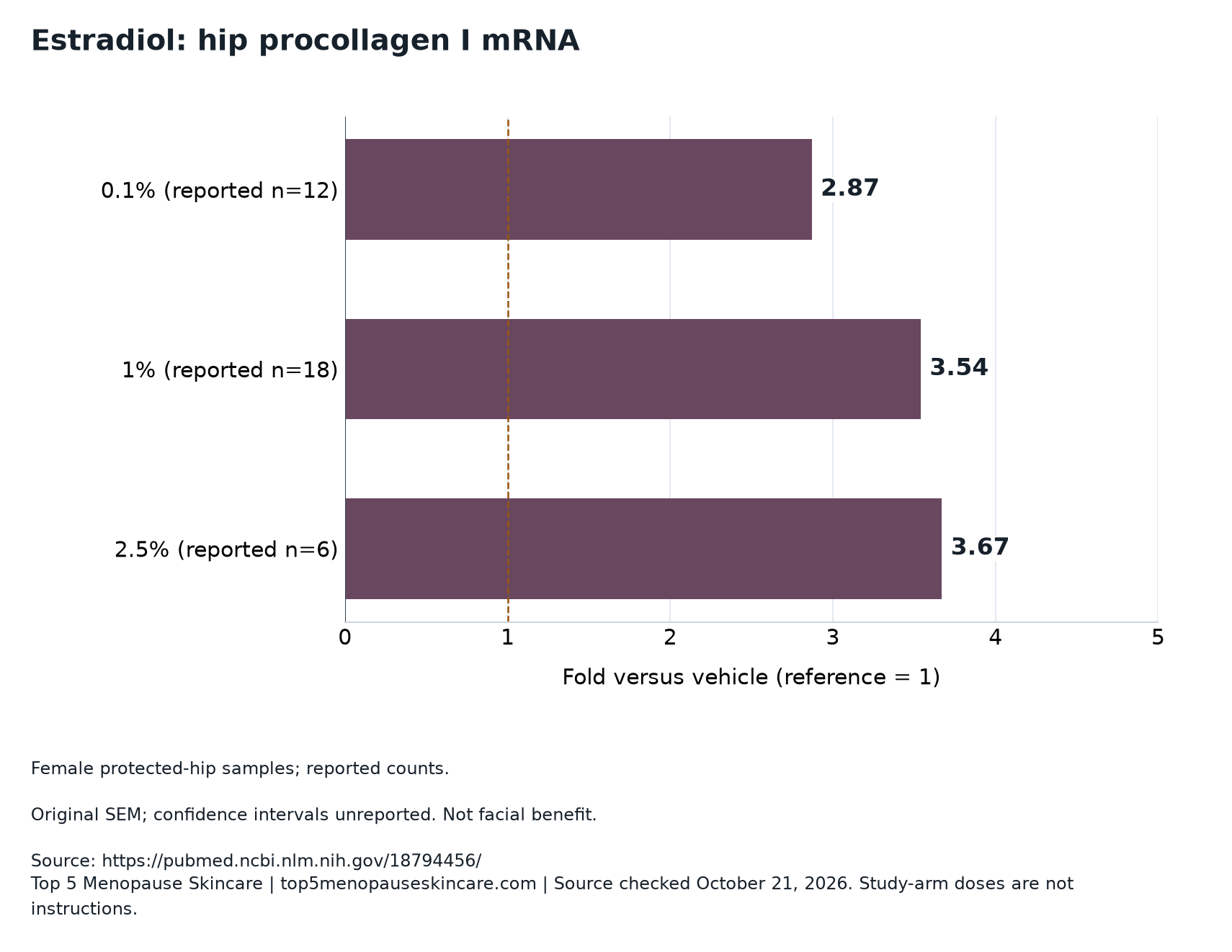
Female protected-hip samples; reported counts.
Original SEM; confidence intervals unreported. Not facial benefit.
Download chart (PNG)Download data (CSV)Download vector chart (SVG)
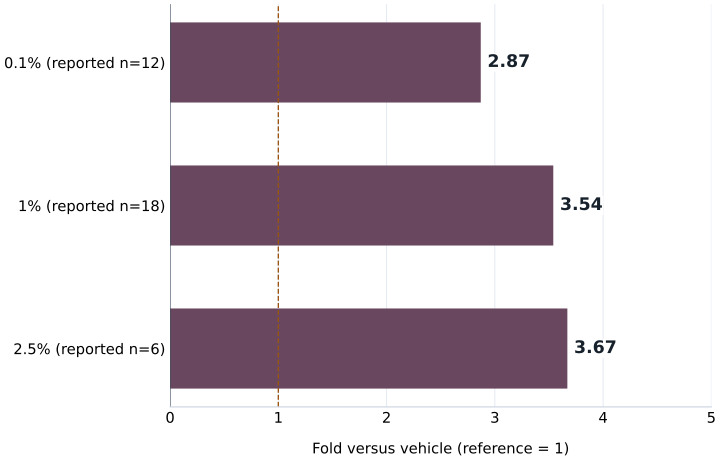
| Historical estradiol concentration | Reported value |
|---|---|
| 0.1% (reported n=12) | 2.87 |
| 1% (reported n=18) | 3.54 |
| 2.5% (reported n=6) | 3.67 |
Count participants before counting measurements
Seventy participants included 40 postmenopausal women and 30 men, averaging about 75 years.
The first reading task is to build a mental ledger with separate entries for people, experiments and measurements. A person can contribute observations to more than one part of that ledger. Adding the observations together therefore does not necessarily recover a count of unique participants. The distinction matters because the independent information in a study depends on its design, not simply on how many numbers appear in a figure.
Consider an invented laboratory dataset with six volunteers, two samples per volunteer and three laboratory readings per sample. That produces 36 readings from 12 samples, but still only six volunteers. The repeat readings might help characterize measurement variability. They do not provide the same kind of population coverage as recruiting 36 people. Neither count is useless; each answers a different question.
A useful claim should identify which count supports it. The guide to reading menopause-skincare claims offers a broader framework for asking whether a headline preserves the underlying comparison instead of borrowing the largest number available.
A mean age belongs to its named group
An average compresses a distribution into one number. It cannot reveal the youngest participant, the oldest participant or how many people lie near the middle. More subtly, an average for a complete research population need not describe the subset contributing a particular measurement. That subset requires its own description.
The table uses invented groups with identical mean ages but different spreads. In the wider group, no one is the average age. In the narrower group, the observations cluster closer to it. This is an arithmetic demonstration, not a claim about the age distribution in the research article. It explains why “averaging” and “all aged” cannot be exchanged in a summary.
Subset selection adds another step. If only the two youngest members of either invented group contributed to a separate experiment, their average would differ from the whole group’s average. Assigning the overall number to that experiment would conceal the selection. Before connecting a demographic summary to a skin result, locate the exact population named by that summary. Our guide to specifying skin changes at midlife similarly encourages defining the question before applying a broad demographic label.
| Invented group | Four ages in years | What the arithmetic establishes |
|---|---|---|
| Wider distribution | 60, 70, 80, 90 | Mean 75; range 60–90 |
| Narrower distribution | 73, 74, 76, 77 | Mean 75; range 73–77 |
| Youngest pair only | 60 and 70; or 73 and 74 | Subset means 65 and 73.5 |
Name the experiment before naming its control
Vehicle-controlled hip/forearm experiments lasted one week; facial before/after observations included five women and five men over two weeks. Photodamaged-site procollagen changes were nonsignificant.
A vehicle is the preparation used for comparison without the active ingredient under investigation. Comparing active treatment with that reference asks about a treatment contrast under the study conditions. Comparing a site after treatment with its own earlier state asks about change over time. The latter observation alone cannot separate treatment from everything else that may have changed between measurements.
These designs should be interpreted according to the question each supports. Suppose an invented measurement rises between two visits. A before/after calculation can describe that rise. A contemporaneous comparison could additionally help ask whether a similar rise occurred without the active ingredient. It would still need appropriate assignment, measurement and analysis to support a causal interpretation.
A body-site comparison introduces further questions about what is being held constant. To identify why results differ between sites, a design would have to distinguish the proposed explanation from other differences. Observing contrasting results can motivate that investigation; it does not, by itself, isolate the biological cause or establish what a longer experiment would show.
Paired samples preserve a person as the comparison unit
In a paired design, two related observations are compared together. An original arithmetic example makes the logic visible: each invented person below contributes a vehicle observation and an active observation in arbitrary measurement units. The relevant difference is calculated within each pair before asking how those differences vary across people. These are made-up values, not treatment estimates.
The baseline measurement differs considerably across the three rows, yet the paired difference is identical. This illustrates why the relationship between observations matters. Separating all six values into an undifferentiated pile would discard the pairing. Calling that pile six independent participants would make an additional mistake about the population represented.
Pairing can help address person-to-person variation, but its interpretation depends on the experiment. The comparison still needs a defensible reference, consistent procedures and an analysis that respects the relationship between observations. A repeated sample can improve precision about one person’s measured response without adding another person to the population. To judge applicability, keep both levels in view: how carefully each response was measured and how many independent people contributed responses.
| Invented pair | Vehicle → active value | Within-pair difference |
|---|---|---|
| A | 10 → 14 | 4 units |
| B | 20 → 24 | 4 units |
| C | 30 → 34 | 4 units |
| Counting rule | Six observations from three people | Three paired differences |
A molecular ratio begins with a reference
A fold value expresses a measured quantity relative to a reference. In an invented example, a molecular measurement of 18 units divided by a reference of six units gives a threefold ratio. This arithmetic does not describe three times as many people improving. Nor does it measure a threefold change in visible appearance. The ratio remains attached to the measurement that generated it.
The label also matters biologically. Messenger RNA is a molecular readout related to gene expression; a protein measurement asks a different question. A visible skin outcome requires another measurement again. An argument connecting these levels should explain the evidence for each connection rather than treating their names as interchangeable. The size of a molecular ratio does not supply the missing clinical conversion.
Uncertainty deserves its own label. Standard error of the mean, often abbreviated SEM, describes uncertainty associated with estimating a mean under an analysis. It is not itself a confidence interval, and it is not a range containing most individual responses. To interpret an interval, one needs the interval actually reported or sufficient justified information to calculate it. Inventing an interval from a plotted point alone would add unsupported precision.
A discrepancy needs reconciliation before arithmetic
Table 1 lists 17 women against Figure 1A’s 18. Initial protein-dose labels conflict: 0.01% figure, 0.1% text.
When counts conflict, the reader should preserve the competing labels rather than silently selecting one. Several explanations might be imaginable, but imagination cannot determine which is correct. A revised table, an author clarification or underlying participant accounting would be needed to resolve the discrepancy. Until then, treating every plotted count as a verified count of different people introduces certainty the record does not supply.
There is also no sound shortcut in adding counts across doses. Before summing, one must know whether the groups overlap, whether observations are repeated and what each count denotes. If that information is unavailable, a larger invented enrollment number is not an acceptable substitute. The arithmetic operation may be easy while its interpretation remains unjustified.
A labeling conflict has a parallel consequence: an uncertain label cannot support a precise recommendation about that label. It is possible to discuss the well-defined parts of a figure while withholding a disputed mapping. Keeping the ambiguity localized is more informative than either discarding every result or presenting a guessed correction as settled evidence.
Cross-study differences do not isolate an age effect
The 2026 conference pilot randomized 90 postmenopausal women aged 50–60 without previous systemic hormone therapy to estriol, estradiol or placebo cream for 12 weeks. Its primary endpoint used investigator ratings from 0–4; 86 completed. Alloy Health funded it.
The indexed 1996 abstract instead describes 59 preclimacteric women, two active estrogen preparations and six months of treatment. Vehicle control and randomization are not established, and funding is unknown from that abstract.
These descriptions identify different research questions. To attribute a difference in findings to age, one would need evidence that separates age from other changes in the experiments. Altering population, formulation, duration and outcome together does not provide that separation. It would be equally unjustified to convert the contrast into a conclusion about time since menopause without measuring and analyzing that variable.
The companion on who a midlife skin study represents examines eligibility in more detail. A useful synthesis preserves the contribution of each design: a laboratory outcome and an observer assessment can inform different stages of a research question. They need not be forced into a simple contest in which one publication proves the other wrong.
Keep serum findings attached to their experiment
Facial 0.2% estradiol raised serum levels twelvefold in women and twofold in men.
The pilot reported no tolerability issues on its scales and no significant serum-hormone differences from placebo. Separately, the 1993 indexed abstract describes 17 women, mean age 57.1, with no significant serum-hormone or vaginal-smear changes over three months. Funding, randomization and vehicle control are unestablished in that abstract.
A formulation-specific observation cannot provide a universal absorption value for other preparations. Changing the molecule, concentration or procedure creates a new question about exposure. Equally, a nonsignificant comparison cannot certify zero absorption or a margin of equivalence. These are different statistical claims and would require different evidence.
Safety interpretation also needs the outcome and interval stated clearly. A blood measurement does not summarize every possible clinical event, while a tolerability rating addresses a different dimension again. This is why the source of an observation should travel with the observation itself. For readers whose immediate concern is irritation, the guide to sensitive skin at midlife helps keep that question distinct from a claim about molecular response or longer-term systemic outcomes.
Disclosures and approval answer separate questions
Pfizer partly funded research; Voorhees received Pfizer consulting payments.
Funding and consulting disclosures are relevant context for evaluating a report, but they do not calculate the treatment effect or resolve a numerical inconsistency. A reader still needs to inspect the comparison, measurements and uncertainty. Nor does a company relationship by itself establish that a current commercial preparation is identical to a research preparation.
FDA states that estriol-containing drugs lack FDA approval and that estriol has not been established as a safer estrogen. Compounded medicines are not FDA-approved and do not undergo premarket approval for safety, effectiveness and quality. Facility registration is not product approval.
As editorial interpretation, these distinctions support a documentary approach to product questions. The CoreAge Rx Time Out review and Alloy M4 review can help readers locate terms to verify; their inclusion here does not link either offering to a measured study benefit. Keep the complete formulation, dispensing information and commercial terms distinct from the research citation. A demographic resemblance or shared ingredient name does not fill a missing connection between a publication and an offering.
Build an evidence chain with an explicit endpoint
A useful evidence chain starts with the question a reader actually wants answered. If that question concerns visible appearance, a molecular result can generate a research hypothesis, but the chain still needs an appearance outcome. If the question concerns comfort, the corresponding endpoint should capture comfort. Choosing an impressive-looking measurement first and assigning a benefit afterward reverses the reasoning.
For future research, the strongest next step depends on which connection is uncertain. Better population descriptions address who contributed evidence. Clear participant accounting addresses which observations are independent. Consistent controls address the contrast being estimated. Longer follow-up addresses a different interval. Measuring both molecular and clinical outcomes can examine their relationship without assuming it in advance.
This approach does not require every study to answer every question. It requires a claim to remain proportionate to the study that supports it. Readers comparing hormone-free midlife moisturizers can apply the same reasoning: define the intended outcome, identify the actual measurement and ask what connects them. Ingredient categories and demographic labels are starting points for inquiry, not replacements for that connection.
Questions about the evidence
Can several skin samples count as several participants?
They count as several samples. If they come from the same person, their relationship must be accounted for in the analysis. Repeated observations can improve understanding of a measured response, but they do not independently broaden the population in the way recruiting additional people would.
Does an overall mean age describe every plotted subgroup?
Only if the report establishes that connection. A subset can have a different distribution from the larger population. The appropriate description is the one attached to the actual group contributing the measurement; an overall summary cannot be assigned to that group automatically.
What does a fold change tell me about appearance?
It tells you about the ratio of the measured quantity to its stated reference. Connecting that ratio to appearance requires a clinical measurement and evidence about the relationship. The arithmetic alone does not translate a molecular change into a visible benefit or a participant response rate.
Why keep a disputed label visible?
A guessed correction can make a summary look cleaner while changing its meaning. Preserving the discrepancy shows precisely what needs clarification. The remaining evidence can still be discussed at the level its labels support, without pretending the unresolved portion has been verified.
Would comparing studies of younger and older people prove an age effect?
Not when the studies also differ in treatment, procedure or outcome. An age-effect claim requires an analysis that separates the proposed age relationship from those other differences. Cross-study contrasts can motivate that question, but they do not supply the controlled comparison needed to answer it.
Editorial assessment
The most informative number is the one whose unit remains clear. People, paired samples, laboratory readings and demographic averages describe different levels of an experiment. Keeping those levels separate prevents a molecular figure from acquiring a larger population or a more clinical meaning as it moves into public discussion. For a reader, the practical task is to follow the chain from participant to comparison to measurement, then identify the evidence required for the proposed benefit. Where a connection is unresolved, the next research question should be made explicit rather than filled by an assumption.
Research access and limitations
The invented numerical exercises explain interpretation; they do not add observations, estimate personal response or resolve discrepancies in a primary record. The 1993 and 1996 reports discussed here are available as indexed abstracts, with correspondingly limited access to methods and disclosures.
Sources and access notes
- Induction of collagen by estradiol: difference between sun-protected and photodamaged human skin in vivo.
October 21 full-paper record retained. The official NLM abstract was rechecked November 14; publisher full text was unavailable. Existing figure values, denominators, dose-label conflicts, experiment details and disclosures were not freshly verified. · Checked October 21, 2026
- Menopause Society 2026 abstract P-124: pilot study of estriol or estradiol facial cream
October 22 record: conference abstract and table. November 14 text extraction was rechecked but omitted numeric table cells; existing chart/table values retain the October transcription and its stated conflicts. No new image or table verification. · Checked October 22, 2026
- Treatment of skin aging with topical estrogens.
Official NLM indexed abstract rechecked November 14, 2026. Full methods and funding were not established by this abstract-only access. · Checked November 14, 2026
- When applied to facial skin, does estrogen ointment have systemic effects?
Official NLM indexed abstract rechecked November 14, 2026. Full methods and funding were not established by this abstract-only access. · Checked November 14, 2026
- FDA Office of Women’s Health: menopause and estriol approval questions
October 21 official-source record retained; November 14 retrieval returned no substantive current policy text. Historical summaries are not newly verified current policy. · Checked October 21, 2026
- FDA: Compounding and the FDA—questions and answers
October 21 official-source record retained; November 14 retrieval returned no substantive current policy text. Historical summaries are not newly verified current policy. · Checked October 21, 2026